Engineering and consulting for shipbuilding and offshore projects
JangWon SM Co., Ltd. (JWSM) was founded in July 2000 as JangWon Engineering, incorporated in May 2002 and renamed JangWon SM in May 2005. Our marine project record covers cargo handling and reliquefaction engineering for LNG and LPG carriers, cargo tank VOC reduction, fuel gas supply systems, local control panels and commissioning support.
Our work has run from FEED and system design through procurement, fabrication, installation supervision, commissioning and onboard verification testing. Most of it was carried out with Daewoo Shipbuilding & Marine Engineering (DSME, now Hanwha Ocean). Our DE-VOC deliveries also involved Navantia of Spain with DSEC as EPC provider, and the owners Kuwait Oil Tanker Company, Bergesen Worldwide and the Ibaizabal Group.
Marine Systems
- DE-VOC System — cargo tank VOC reduction for crude oil loading. Applied to 10 tankers between 2009 and 2019.
- Fuel Gas Supply (FGS) System — high-pressure LNG vaporization and fuel delivery for ME-GI engines. Test facility engineered, built and commissioned for DSME in 2010–2011.
- Propeller Shaft Clutch Operation Panel (PSCOP) — local clutch control panel for twin-screw LNG carriers. Supplied for 20 DSME-built vessels in 2006–2008.
Fuel Gas Supply (FGS) System
High-pressure LNG vaporization and fuel delivery system for ME-GI engines
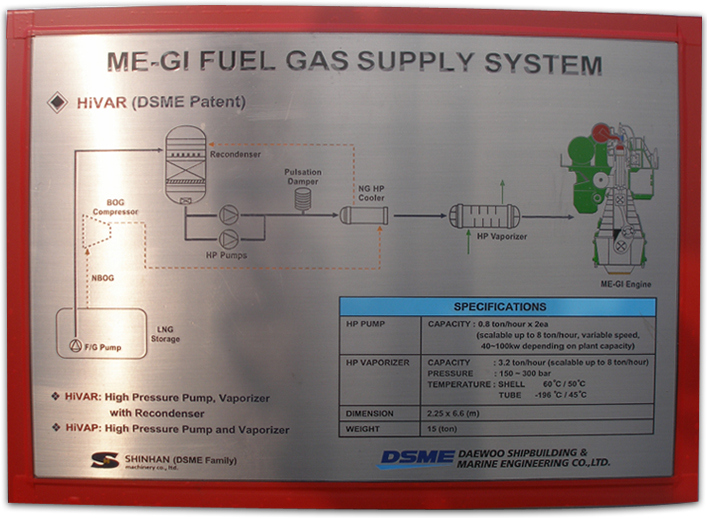
The Fuel Gas Supply (FGS) system supplies vaporized LNG fuel to the main ME-GI engine through a high-pressure and precisely controlled process. It consists of a suction drum, high-pressure pumps, high-pressure vaporizers, a glycol-water (GW) heating system, and high- and low-pressure piping and valves.
LNG stored in the tank is fed to the suction drum, where pressure is maintained slightly lower than the LNG tank pressure. The liquid is then pressurized by the high-pressure pumps and sent to the HP vaporizer. Inside the vaporizer, LNG flows through the tube side while heated glycol-water circulates in the shell side, enabling efficient vaporization. The resulting natural gas is supplied to the ME-GI engine for combustion.
System Configuration
- FGS Skid (hazardous area): suction drum, high-pressure pumps, HP vaporizer
- GW Skid (non-hazardous area): glycol-water tank, feed pump, electric heater
The suction drum serves as a buffer tank for stable operation. The high-pressure pumps raise the LNG to the delivery pressure required by the engine, and the vaporizer heats the pressurized LNG to the design temperature, ensuring a reliable gas supply to the ME-GI engine.
Project Record
| Year | Client | Project | Scope of Work |
|---|---|---|---|
| 2010–2011 | Daewoo Shipbuilding & Marine Engineering (DSME) | ME-GI fuel gas supply system test facility, delivered August 2010 | FGS system engineering; procurement and manufacture of components; skid fabrication at the JWSM works in Gwangyang; commissioning and testing at DSME Okpo shipyard and joint testing at the MAN Diesel & Turbo works in Copenhagen, Denmark; documentation |
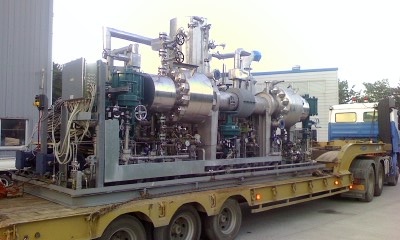
The work above was carried out on a test facility built to verify the ME-GI engine and its fuel gas supply system, not on a shipboard installation. JWSM performed the system engineering, built the skids in its own workshop, and took part in the joint test program with MAN Diesel & Turbo in Copenhagen.
Scope of Supply
- FGS process and system engineering, including heat and mass balance for the vaporizer and GW circuit
- Procurement of high-pressure pumps, vaporizers, valves and instruments
- Skid assembly and acceptance testing
- Commissioning support and engine-side joint testing
- Preparation of operating and maintenance documentation
Propeller Shaft Clutch Operation Panel (PSCOP)
The Propeller Shaft Clutch Operation Panel (PSCOP) is a local control panel for clutch operation on twin-screw LNG carriers.
Twin-screw LNG carriers are equipped with two main engines and two propeller shafts, each shaft fitted with a clutch unit. When one engine or propeller shaft fails, the corresponding clutch can be disengaged to isolate the affected unit and re-engaged once the fault has been corrected.
At the request of Daewoo Shipbuilding & Marine Engineering (DSME), JangWon SM Co., Ltd. developed the PSCOP. Indications and alarm states are transmitted to the Integrated Automation System (IAS) for monitoring and display.
The PSCOP uses conventional relay logic. Clutch actuation is carried out by hydraulic solenoid valves operated from push buttons on the local panel.
Supply Record
| Period | Client | Application | Quantity |
|---|---|---|---|
| 2006–2008 | Daewoo Shipbuilding & Marine Engineering (DSME) | Large LNG carriers for Pronav, Lasgas and QGTC | 20 vessels |
Our scope covered design, manufacture and commissioning of the panels.
Major Project Experience (1999–2021)
| Year | Client / Owner | Project / Vessel | Scope of Work |
|---|---|---|---|
| 1999 | DSME | Bayu Undan LPG FSO | Participation in the cargo handling system proposal, covering cargo pumps, reliquefaction and refrigeration systems |
| 2001 | DSME | Shanha / Exima LPG FPSO | Cargo handling engineering in consortium with GOC (Germany); boil-off gas calculation; reliquefaction and de-propanizer design |
| 2002 | DSME | LNG re-gasification vessel | Localization of re-gasification unit engineering; coordination of the engineering contract |
| 2005 | DSME | 78,500 m³ LPG carrier (H/N 2304) | Cargo handling system engineering; deckhouse piping arrangement and component listing |
| 2005 | DSME / Bakri, K-Line | LPG carriers (H/N 2311, 2312, 2313, 2314), 4 ships | Cargo handling engineering with the GOC consortium; reliquefaction and de-propanizer design |
| 2005 | DSME / EXMAR | 83,800 m³ LPG carrier (H/N 2215) | FEED engineering for the reliquefaction plant |
| 2005–2007 | DSME | Q-Flex LNG carriers (H/N 2249–2253), 5 ships; DSME “D-Reli” reliquefaction system | FEED service for the reliquefaction plant (Oct 2005) and project engineering service for the D-Reli system (Mar 2007); preparation of owner pre-qualification documents |
| 2006 | DSME | Q-Max LNG carriers (H/N 2255–2257), 3 ships | FEED engineering for the reliquefaction plant |
| 2006–2008 | DSME / Pronav, Lasgas, QGTC | Large LNG carriers, 20 ships | Design, manufacture and commissioning of the Propeller Shaft Clutch Operation Panel (PSCOP) |
| 2007 | DSME | Q-Flex large LNG carriers (H/N 2264–2266), 3 ships | FEED engineering for the reliquefaction plant |
| 2007 | DSME | LNG cargo tank model, Okpo shipyard | Tank model for pump tower load measurement; supply of dynamic pressure sensors (research project) |
| 2007–2008 | DSME | Sealed LNG carriers (H/N 2270–2272), 3 ships | Cargo Level Confirming System: system consulting, owner and class proposal, basic and detail design, application software development |
| 2008 | DSME / Exmar, Maran Gas, Gulf Marine | LPG carriers (H/N 2315–2323), 9 ships | Cargo handling operating manuals; consolidation of vendor information and yard drawings |
| 2008 | DSME / Petroserve | Semi-submersible drilling rig (H3024) | Commissioning procedures for 85 systems; punch list follow-up |
| 2009 | DSME / Odjfell | Semi-submersible drilling rig (H3023) | Revision of commissioning procedures; punch close-out |
| 2009 | DSME / Transocean | Drillships (H3501–3504), 4 units | Punch close-out consulting |
| 2009–2012 | DSME | LNG technology test and model facilities | Liquid-nitrogen re-gasification, CO2 removal from LNG, refrigerant for LNG production and PCB-type LNG vaporizer: concept and basic design, skid model plant fabrication, installation supervision and commissioning |
| 2009–2013 | DSME / Bergesen Worldwide | Crude oil tanker “BW NYSA” (H5123), 1 ship | DE-VOC system: design, procurement, manufacture, installation supervision, commissioning and reporting. Onboard demonstration; system completed in March 2011 |
| 2010–2011 | DSME | ME-GI fuel gas supply system test facility | System engineering, procurement and fabrication, skid manufacture at the Gwangyang works, commissioning at DSME Okpo shipyard and joint testing at the MAN Diesel & Turbo works in Copenhagen |
| 2013–2014 | DSME / Kuwait Oil Tanker Company | 317,000 DWT VLCC (H5389–H5392), 4 ships | DE-VOC system, installed January 2013 – October 2014. Onboard verification test August 2014 – April 2015 |
| 2013–2014 | DSME / Kuwait Oil Tanker Company | 110,000 DWT Aframax product carrier (H5393), 1 ship | DE-VOC system, delivered October 2014 |
| 2015–2019 | Ibaizabal Group / Navantia (Spain), EPC provider DSEC | 156,000 DWT Suezmax crude oil tankers (PE 0540–PE 0543), 4 ships | DE-VOC system, installed October 2015 – May 2019 |
| 2018–2021 | — | Reliquefaction plant for a new LPG carrier type | Design of the reliquefaction system |
Class Review and Certification
| Date | Item |
|---|---|
| Jun 2016 – Apr 2017 | Testing for the Lloyd’s Register additional class notation “VOC-R” on two 156,000 DWT crude oil tankers at Navantia |
| Jul – Dec 2017 | ABS Statement of Compliance for the DE-VOC system |
Publications and Presentations
| Date | Item |
|---|---|
| Oct 2011 | Principle of the DE-VOC system presented at the ME ShipTech 2011 conference |
| Jul 2012 | Technical presentation at the Kuwait Oil Tanker Company head office |
| Oct 2013 | Application cases presented at the ME ShipTech 2013 conference |
| Sep 2015 | DE-VOC system featured in Lloyd’s List |
| Nov 2015 | System introduced to Greek owners and the shipping community |
The DE-VOC technology is based on a patent held by Daewoo Shipbuilding & Marine Engineering (DSME, now Hanwha Ocean). JangWon SM took part in the joint development, and DSME granted JangWon SM the right to use the patented technology. Detailed project references are available on request.
Have a project in mind?
Send us your specification and we will respond with a technical proposal.
